May 19, 2013

Blooms On A Budget

Do you dream of having a really lush and beautiful garden. I do! We have a large suburban lot – a corner lot – and I’ve been faced with trying to landscape it without emptying our 401K ! Here are some things that I’ve done in my Georgia garden that have helped me garden on a budget.

Thrifty Gardening tips

I hope some of you find this helpful. I’m sure all you experienced gardeners already do these things and maybe you could share what has worked for you in the comments.

My Thrifty Gardening Tips

1. When buying plants always check to make sure that your cell packs have plants in each cell. Sometimes a 6 pack will only have 5 cells filled with plants. I also check to see if I can find a cell pack with extras that I can divide. When I buy the single pots I try to make sure I buy one that is easy to divide.

4 basil plants in a pot

This pot had four very distinct plants. The others I looked at had one or two bushier plants.

4 basil plants from one pot

This was cheaper than buying a cell pack!

layering hydrangeas to propagate@ A Cultivated Nest

2. Learn to propagate! It’s really not that hard! I LOVE hydrangeas and they are so easy, easy to propagate. This is my favorite way to propagate hydrangeas and forsythias..

It’s called ground layering.

I select a branch that is close to the ground.

I scrape a little bit the outside of the stem off preferable at a leaf nodule.

Lay the part down into the dirt and put a rock on top and then wait. I usually do this during the growing season – spring and summer.

Soon you’ll have another plant. I wait until the new plant is pretty well established before I cut it off from the mother plant and I usually leave it where it is for a few weeks so it can get used to growing on it’s own.

The hydrangea pictured below, under the Dogwood is about 4 years old now. The only hydrangea I’ve had trouble with is Oakleaf but usually this variety will have off shoots that you can dig up.

hydrangea growing under a dogwood tree

All the hydrangeas along this fence have been propagated by me with the exception of the first one. As you can see, they get smaller as you get to the end because those are the newer ones. All you need is patience and the will to suppress the desire to impress your neighbors with an “instant” garden. (The plant to the right of the last hydrangea are some blackberries creeping under the fence)

hydrangea border

I do the same thing with forsythia. Although, I’ve found that left to it’s own devices it will do it by itself! Once you have one Forsythia you have the potential to have lots of babies under and around the main plant.

forsythia

This branch has rooted and now it’s time to detach it from the mother plant.

Vines are also good candidates for this method.

The other way is to propagate is to take a cutting, especially if you’re trying to do many plants at once. Here is how Martha Stewart does it.

small container knockout rose bush

3. The other thing I do is buy the smaller pot. This little Knock Out Rose will be as big as this older one in one or two years. Especially if it’s happy where it is and the soil is good. Things will fill in. Also, plants that are started smaller are usually healthier than planting larger versions.

4. Plant division is another way to propagate what you have! That’s why even though perennials are more money upfront, thrifty gardeners know that you’ll get more than just that one plant in the end.  Day Lily, Daisies, Coneflower, Yarrow, Black-Eyed Susan, Mint, Sage, Bleeding Heart and Lupines are just some of the the plants that you can propagate by division.

3 colors of lilies

Plants that grow from bulbs, tubers, rhizomes are super easy because they automatically multiple underground and therefore it’s easy to see where to divide them. Bearded Iris, Daffodils, Gladiolas, and Dahlias are examples of these types of plants.

The common rule of thumb is to divide spring-blooming perennials in the fall to to divide fall-blooming perennials in the spring. Summer bloomers can be divided anytime. If you divide in the summer be sure to give your new plants extra TLC because of the heat and less rain. Remember even though perennials may seem expensive, for a small investment you’ll get a big return.

Daylilies – I will dig up clumps of daylilies and plant them in other parts of my yard. I usually wait until they bloom because otherwise I don’t know what color they are. But if you’re more organized than me and mark your plants then early spring is a good time. I just give mine extra water. Like this Stella d’Oro that I just divided and moved here.

These Daylilies were divided and moved here. This is one year growth!  See how big they are already. They can be divided again this year.

Hostas are perfect for propagating by division!  I usually dig the whole plant up and then you can see where you can separate it. Just be sure that each piece has its own roots.

I normally divide my Hosta in early summer or late fall so I know what kind it is. By then it’s usually fairly large  and it’s pretty easy to see where to make divisions. Just be sure to give it’s lots of water if you do this in the summer!

Every year I buy a coleus and I always say I’m going to propagate it since I love them. They come in so many colors these days and now there are ones that can handle sun. Did you know that the more red pigment in the leaves the more sun it can tolerate? So this year I remembered and all you have to do is: pinch some off!

Yep, Coleus will root in water! Just change the water every few days and you’ll have a roots in no time.

purple coneflowers

If you have more time than money, like me, this is the way to go! There are many, many more plants than I showed in this post than can be propagated and divided. Of course growing from seed is a huge money saver too as is buying bulbs and swapping with friends.

I hope you’re inspired to try some of these techniques for a cost cutting garden!

You might also be interested in:

  Gardening 101 Series

***This is an updated version of an older post***

DIY Saturday – Make Your Own Flower Tower

Happy Weekend Everyone! Here’s a really easy project that will make quite the statement in your garden! A DIY flower tower!

DIY Flower Tower

Instead of a flower tower you could also make it a vegetable tower. It’s really like a big strawberry planter – so you could do strawberries/lettuce/herbs or a mixture of things. As long as they all have the same soil and watering requirements they should all live happily together. This is great space saver and an example of gardening vertically!

DIY Flower Tower

Supplies:

  • 4 ft of galvanized wire fencing (less if you make it smaller)
  • tin snips
  • zip ties
  • landscape fabric
  • flower pot
  • flowers
  • potting soil
  • scissors

Directions:

For the tutorial on how to make your own flower tower planter go to the Home Depot Garden Club (this is the pdf page so you can print out the instructions)

***Link up your creative homemaking/gardening/cooking posts tomorrow at the Creative HomeAcre Blog Hop that I’m co-hosting. It’s a great way to find new blogs and have new readers find you!****

What’s Growing In The Garden This Week?

The garden is flourishing due to the abundant rain and sunshine that’s we’ve experienced lately! I thought I’d share of few photos of the flowers and edibles that are growing in my yard.

pink foxglove

I’ve got the most beautiful stand of foxgloves! They popped up where I usually have hollyhocks and the hollyhocks popped up elsewhere (they haven’t bloomed yet).

blackberries growing along the fence

The blackberries are going to be amazing this year! All those blossoms will be berries.

angel statue in a cottage garden

All the roses are blooming beautifuly. The pale peach rose in the foreground is a Savannah Rose.

strawberry plants

The strawberries will be ready to eat soon if I can keep the chipmunks out! I have them netted to keep the birds out but those chipmunks always find a way  in AND they don’t eat the whole berry. They’ll just take a bite! So annoying!

red climbing rose

The red climbing rose that’s at the front of the house on one of the pillars is in bloom. It’s looked better other years – but still quite pretty against the white of the house.

artichoke growing on plant

I’m getting artichokes!! This is my first year! I have two artichoke plants but this one is doing better than the other one.

purple clematis

The Clematis always surprise me! One day there’s nothing and the next you have some big gorgeous blooms!

pink knockout rose

Lastly, one of my pink Knock Out Roses.

I wanted to invite all you creative homemakers to The Creative HomeAcre Blog Hop that I’m co-hosting on Sundays. The party link is up really early so you can link up your post before heading out to enjoy your Mother’s Day!

What’s Blooming In My Garden This Week

The weather has just been so deliciously gorgeous lately! I’ve been spending a quite a few hours each day outside and enjoying it so.  I thought I’d share a few photos of what’s blooming in my Atlanta garden this week.

yellow iris

The trees are about all leafed out and lots of  flowers are blooming like these yellow iris .

Japanese Maple

The azaleas are blooming.

blooming azaleas

The white ones are so beautiful when the first bloom. Unfortunately the white blossoms turn brown as they start to fade.

primroses

These are some of the primroses I used in my table top spring garden in February that I planted outside last month.  They seem to be revived by all the rain we’ve had (although looks like something been nibbling the leaves).

yellow lady banks rose

My yellow Lady Banks rose is fading a bit but still looking wild and lovely. There’s a crepe myrtle behind it and it grows up the branches. Which makes the crepe myrtle look like it has little yellow flowers until it leafs out.

garden mirror

The timing of the two is just perfect. If you didn’t check out my written word mirror project at Kathy’s blog when I posted it before – here’s the link again Creative Home Expressions

perennial salvia

I have perennial salvia in lots of places.

salvia growing in front of a garden conservatory made from old windows

Here’s some salvia in front of huge artichoke! I love salvia – it’s got beautiful blue-violet flowers.

What’s blooming in your garden? Hopefully no one is getting anymore snow!

One Raised Bed Is Planted!

My backyard vegetable garden is such a mess right now! (And you know normally it’s very neat!) We’re taking a few of the older raised beds out and making new ones in a size that I’ve found that I really like – 6×3 and 11 inches deep. I’m 5’4” and I’ve tried all different sizes of raised beds and that size is the easiest for me to reach into the middle of.  I wanted to show you the one bed that I have planted since I know it can be hard to decided what to plant with what if you’re new to growing vegetables.

planting in  a raised bed

I do a combination of companion planting and square foot gardening - which works for me in this garden in this climate.

two 6x3 raised beds

These are two beds have had their soil refreshed  and are ready to go but only one is planted so far.

raised bed companion planted

This bed is the tomato/pepper bed.

raised bed companion planted

Here’s a closer look.  The borage is seeded next to the marigold.

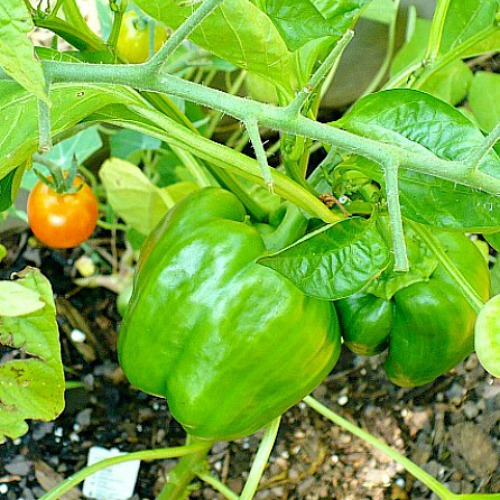
bell peppers & tomatoes planted in a raised bed

What’s in this raised bed:

  1. 3 tomatoes
  2. 4 bell peppers
  3. 2 lemon cucumbers – grow up the arbor
  4. 1 swiss chard-testing this to see if it likes growing in the shade of the tomato
  5. 1 spinach- testing this for same reason as above
  6. leaf lettuce – leafy plants act as a mulch and in the heat of summer may benefit from the shade of the tomato plants
  7. carrots
  8. marigolds
  9. borage – blue flowered herb that’s good at attracting pollinators, is supposed to guard against tomato hornworm , supposed to improve the flavor of tomatoes if grown nearby, the young leaves & flowers are edible and there’s a whole list of things it supposedly does if you’re into medicinal herbs.

I will also sneak some nasturtiums into outer parts of the bed . I’m testing the leafy greens to see if they like growing in the shade of taller plants.

strawberry-asparagus-bed

We took out the old raspberry bed (I planted the raspberries out in the yard along the fence). I’m putting a little garden storage shed in it’s spot. My husband has offered to build me a little shed but I may just buy one – depends on his schedule. I need some place to keep my tools and other things I need all the time without trekking into the garage or barn for them.

cabbage in a raised bed

One bed is already gone. The other will be gone by next weekend. We’re putting two 6×3 raised beds in this spot. I think those skinny ones were 2×8 .  Easy to work in but I found they dried out too quickly in our hot Georgia summers.

artichoke

artichoke

I’ll have 6 raised beds to plant and I’ll show you each one as I get it planted and the whole garden once it’s all cleaned up!

Feel free to ask questions – I’ll answer them in the comments.

Linking to: Wildcrafting Wednesday

Pretty Potting Bench Ideas & Inspiration

This is the potting bench I used to have in the vegetable garden. It finally fell apart (although why something that’s supposedly made for the outdoors would rot is beyond me). My husband did make me a nice long one last year and although it’s functional I think it needs a few finishing touches. So I’m potting bench plotting dreaming (my poor husband, his list of projects just gets longer and longer…).

potting bench ideas

Here are a collection of potting bench ideas that I’m using as inspiration for my potting bench makeover:

blue potting bench

This is like the one my husband built for me but I have sink in mine from Our Fifth House

red potting bench

This red upcycled potting bench is from the garden web

rustic barnwood potting bench

Love this rustic barn wood potting bench with a great sink from Country Cottage Living

skirted potting bench

Cute, cute, cute  skirted potting bench from Craftsy

potting bench with chain link fence back

This is a table with a chain-link gate attached to the back Knitty Vintage & Rosy

potting bench

Beautiful potting bench with upcycled window from Buckets of Burlap

potting bench with banner

This pretty potting bench with the cute grow banner is from Hymns and Verses

diy pallet potting bench

Cute diy pallet potting bench from Ana White

upcycled door potting bench

This one looks pretty easy to make - upcycled door potting bench from Confessions of a Curbshopaholic

Having a potting bench makes working in the garden so much easier and more organized. It’s really so much nicer being able to work at table  height instead of bending over to fill pots etc.

How about you? Do you already have a potting bench or table?

****Kindly pin from the original source, thanks!****


Adding Flowers to Your Vegetable Garden – Attracting Pollinators

Some people think that flowers should just grow in a flower garden and vegetables should just grow in a vegetable garden. I have always either surrounded my vegetable gardens with flowers or I’ve interplanted flowers in the vegetable garden. I know a lot of you are in the process of planning your vegetable gardens and I just want to encourage you to plan on adding flowers this year if it’s something you don’t already do.

adding flowers to your vegetable garden

There are several good reasons to add flowers to your vegetable garden besides the beauty they add. Although “companion planting” is a debatable gardening method (one which I find fascinating), it has been proven that flowers attract pollinators to a vegetable garden.

flowers in a vegetable garden

A flower’s blossoms and fragrance attracts pollinators that are important to the success of your vegetable garden. Although there are some plants that are wind or self-pollinated, most plants need a pollinator.

pollinator in vegetable garden

Who Are Pollinators?

Bees, butterflies, moths, bats, humming birds, beetles,
wasps and flies.

What do pollinators do?

Basically, your garden needs pollinators like bees and butterflies to transfer the pollen from the male part of your vegetable to the female part in order for fruit to develop. Vegetables that we grow for the leaves like lettuce & spinach and vegetables that we grow for their roots like carrots and radishes don’t need pollinators. Vegetables like peppers are self-pollinating but set more fruit if pollinated by bees. But vegetables like squash definitely need pollinators otherwise you have to pollinate those squash blossoms by hand!

squash blossoms need pollination

It is said that bees are more attracted to flowers that are white, yellow, orange, scarlet, blue, violet and purple such as coneflowers, cosmos, bachelor buttons, daisies,  zinnias and sunflowers. Butterflies like yellow, red and purple flowers like asters, calendula,  and sunflowers. Hoverflies and wasps  like candytuft and daisies.

Borage which actually is a herb is supposedly one of the best bee attractors .  I’ve never grown it before but I ordered some seeds this year so I’ll be trying it out.

A word about growing sunflowers in your vegetable garden.

sunflower

One year I used mammoth sunflowers in a “3 sisters”  method which normally is growing corn, squash and pole beans together and I discovered that squash beetles loved laying their eggs on the underside of the huge leaves of those sunflowers – waaaay at the top!  I had to climb on a ladder to get at those squash beetle eggs and had a very hard time controlling them until I ripped out those big sunflowers.

So I don’t grow the really tall sunflowers in my veggie garden anymore just the shorter ones!

sunflowers in the vegetable garden

Pollinators like bunches of flowers which is why I often plant a container of flowers and place it that the end of a bed. I also dedicated one raised bed just for flowers last year.

growing flowers in containers

Some other tips for attracting pollinators to your garden:

-plant native flowers  because your native bees are more attracted to flowers that are familiar to them

-do not use chemicals in your veggie garden. Pesticides and herbicides kill bees and honey bee populations are declining as it is! If you must use a pesticide try to do so in the late afternoon or evening since bees are most active early in the day.
growing flowers with vegetables

You can find a list of plant names that will attract pollinators at  Pollinator.Org  All you have to do is enter your zipcode to find your ecoregion and get a list of plants that are specific to where you garden (the list is at the end of the document).

I think flowers deserve to be in all vegetable gardens! Will you be adding flowers this year?
Follow Me on Pinterest

The First Blooms of Spring In My Garden

The first day of spring isn’t officially until March 20th but we’ve had some really lovely spring-like afternoons here and there already.   I thought I’d share some of the first blooms of spring in my garden!

first blooms of spring

I’ve taken advantage of the few warm afternoons we’ve had and started cleaning up my garden. Doing a little bit as time as weather permits is the only way to keep on top of things without getting stressed out by how much there is to do in the yard (at least for me). I’ve been focusing on one bed in particular. It has some of my earliest spring blooming flowers.

spring blooms in the River Birch bed

It’s funny how spring bulbs bloom at different times in different places in the same yard. This bed always blooms first. A bed I have in front yard always blooms last. Some of my neighbors already have tons of daffodils. Some of mine have bloomed and some are just beginning to  push up

spring flowers

Don’t the first blooms of spring just make you smile!

daylillies and spring blooms

Even the daylillies are starting to pop up.

peach blossoms

My dwarf peach tree has blossoms! I hope I get some peaches this summer. I got one last year – the squirrels & chipmunks got the rest!

garden cherub and daffodils

Spring bulbs are really magical! One day there’s nothing, maybe the tips of some green leaves and the next day you look and all of sudden you  have some blooms!

forsythia in bloom

The forsythia is beginning to bloom and that’s a sure sign that spring is on it’s way!

Is your garden starting to bloom or are you still dealing with snow?


Adding Curb Appeal With Mailbox Gardens

What’s one of the first things you see when you drive up to someone’s home? The mailbox garden! I have a pretty small island around my mailbox but I’m going to make it a bit bigger this year so it can be a little self-contained cottage garden.  Here are some  pretty mailbox gardens for inspiration because I’m in denial that we’re having freeze warnings every day! In my head it’s spring!

mailbox garden

This is the cottage mailbox garden of my favorite neighbors (they have 7 dogs – all rescues!).

mail box garden

Although I love the look of a mailbox surrounded by climbing vines, I don’t like having to dodge the bees while trying to get my mail out! I’m sure the mail carrier doesn’t want to have to do that either. Also, you have to keep your flag clear so I think vines should be set back like this one. source: Pinterest

Mailbox Garden with daylillies

I like this idea of using daylillies via Shauna Coronado. I have so many of them they would be easy to divide and they’re drought tolerant.

mailbox_garden

My mailbox is as close to the road as this one. I have very little planting space in front of it so my mailbox garden would have to also be more behind and to the side. I like this idea but on a smaller scale for me.  via About.Com Flowers

street side mailbox garden

This street side mailbox garden is pretty amazing! Although I don’t know how you get in there to actually get your mail. via Fine Gardening

stenciled mailbox

I always enjoy it when people have interesting mailboxes. via Gardening With Bulbs We have a school bus driver in the neighborhood and she has a school bus shaped mailbox!

Mailbox garden in a raised bed

I like this one as it looks likes it’s in a raised bed. Maybe it would keep the dogs out! via BHG

Of course, mailbox gardens can be more formal & structured (shrubs,ground covers, be conservative with flower colors). I just like a cottage garden look.

I think a little something around your mailbox, even if it’s a flat of begonias, can add lots of curb appeal to your home. Just remember to choose plants that can withstand whatever road side conditions  you have and keep the mail carrier in mind.  I often see mailboxes covered with climbing roses around them and wonder about the thorns!


Garden Technology – How To Plan Your Vegetable Garden

Figuring out what you’re going to grow where and how much space to put in between vegetables can be a daunting task even for experienced gardeners. Every year I draw out my garden plan on a sheet of graph paper. This year I’m trying something new to help me plan my vegetable gardenonline garden planners!

Garden Techology how to plan your vegetable garden

As I discussed in Gardening 101- The Basic of Planning Your Vegetable Garden,  the first thing you need to do is find a good site for your garden. Once you have a chosen where you’re going to put your vegetable garden, you can then move on to layout and picking what you’re going to grow.These online garden planners help you figure out how to layout your vegetable garden and offer helpful tips on when to plant, what to plant and how to space what you plant.

SmartGardener

This website provides you with  a custom garden plan.. You have to sign up with an email and then you get to name your garden. You also input your zip code and how many people your garden is supposed to feed. Then you pick raised beds, in the ground or containers. Select your plants and it creates a garden plan. It will arrange the plants for you if you want or you can do it yourself with a drag and drop feature. It also  gives weekly to-dos by email or your online journal.

Custom Garden Planner

There are many features that I like about this site like the weekly reminders, that you can choose containers (!)  and that it gives you an estimate of your different growing seasons based on historical data. It has an extensive list of vegetables. For example I’m growing peanuts this year and it had 8 varieties to choose from. But I’m also growing cotton and that was not on the list.

GrowVeg.Com

This interactive vegetable garden planner lets you draw out your vegetable garden with drop and drag feature. It has over 130 common vegetables, herbs and fruit for you to  add to your planner. It is free for 30 days and doesn’t require a credit card to begin with. You do have to sign up with an email address.

interactive vegetable planner

What I liked about this one is that it has short informative videos on Square Foot Gardening & Succession Planting. Once you pick your plants, it gives you their spacing and when to plant them based on your location.

Gardener’s Supply Co.

This website has already made up vegetable garden plans like the All American (example down below) or the High Yield which all come with a shopping list, planting guides and layout.

pre planned vegetable garden

Or you can use Design Your Row or Bed option by dropping and dragging your vegetables for a custom plan.
This is the easiest and most user friendly of the three online garden planners but only has just the most common types of vegetables available for adding to your planner.
vegetable garden

There are a few more online planners available but these are the first three that I’ve tried. I’ll do another post when I have a chance to try the others out.

So what do you think? Are you old school paper and pencil or are you going to embrace garden technology this year when planning your vegetable garden?

Please check out my Gardening 101 Series for more gardening tips

Gardening 101

Follow Me on Pinterest

Using An Old Bathtub As A Container In Your Garden

I really want to get out in the garden! I have so many plans and I want to start on them now! One thing I’ve always loved is whimsy in the garden and  I am looking for an  old cast iron bathtub that I could plant with flowers or maybe bamboo for my backyard along the fence line.

bathtub flower planters

Here are some cute old tubs planted as gardens.

Petunias growing in an old clawfoot tub

Purple petunias planted in an old purple bathtub. via Black Gold Garden Compost (there seems to be something wrong with their server so I unlinked it)

annuals planted in a bathtub
Annuals planted in a bathtub via GardenWeb

flowers planted in a bathtub

Flowers planted in a bathtub via flickr by Kle58

pond in a bathtub

They would make great water garden planters too. via the Daily Press

bathtup planter

I love how this one is planted in one type of flower. via Fun Flower Facts

bathtub-planter

This one is styled by Sunday Hendrickson for Flea Market Gardens Magazine

These won’t work for every garden but they would be lovely in a cottage style garden!

Follow Me on Pinterest

Related Posts Plugin for WordPress, Blogger...